














You mow the lawn on a sunny Saturday, stand back to admire your work. But within days, the grass has turned yellow and patchy. Or weeds have appeared from nowhere. Sound familiar?
Most lawn problems are not caused by poor soil or the wrong fertiliser. They are caused by how, and how much, you cut. Mowing at the wrong height stresses the grass at a biological level, and the damage accumulates quietly. Fortunately, one golden rule addresses all of it: the 1/3 mowing rule. Master it alongside the right seasonal heights, and you will have a science-backed framework for a greener, weed-resistant garden all year round.
Table of Contents
Key Takeaways
- The 1/3 Limit: Never remove more than one-third of the grass blade's total height in a single mowing session.
- The 1.5x Formula: Mow before the grass reaches 1.5 times your target height. If tour target is 4 cm, mow before it hits 6 cm.
- Seasonal Adjustments: Taller grass in summer defends against heat and weeds; a lower cut in spring encourages lateral growth.
- Avoid the Chop: If the grass is overgrown, reduce height gradually over multiple sessions, never in one dramatic cut.
What Is the 1/3 Rule of Mowing?

The 1/3 rule of mowing is the most fundamental principle in turfgrass management. It states that you should never remove more than one-third of a grass blade's current height in a single mowing session.
As explained in Fundamentals of Turfgrass Management by Nick E. Christians, the green leaf blade is the plant's primary photosynthetic organ. Remove too much in a single cut, and you are not just trimming the lawn; you are triggering a physiological stress response that can take weeks to recover from.
If your target height is 4 cm, the grass should never grow beyond 6 cm (1.5 × 4 cm) before you mow. Everything in between is the healthy operating range, and this applies to virtually all cool-season and warm-season grasses grown in European gardens.
How to Apply the 1/3 Principle Manually
The practical formula is simple: mow before the grass reaches 1.5 times your target cutting height. Here is how to put it into action:
- Set your target height for the season (see the chart below).
- Calculate your trigger point by multiplying the target by 1.5. At a 5 cm target, mow before it reaches 7.5 cm.
- Mow consistently. Once a week in spring and early summer; every 7–10 days when summer growth slows.
- Adjust the deck before the first pass, not halfway through.
If the grass is already overgrown, never cut straight back to your target. Use the step-down method instead: cut to approximately two-thirds of the current height, wait 2–3 days, then repeat until you reach your target. Attempting a single dramatic cut — known as scalping — is one of the most damaging mistakes in garden maintenance.
How a Robot Mower Automates the 1/3 Rule
The biggest real-world obstacle to following the 1/3 rule is consistency. Life gets busy, a fortnight passes, and the rule is broken before you realise it. A robot mower solves this by mowing frequently enough to keep grass perpetually within the healthy one-third window.
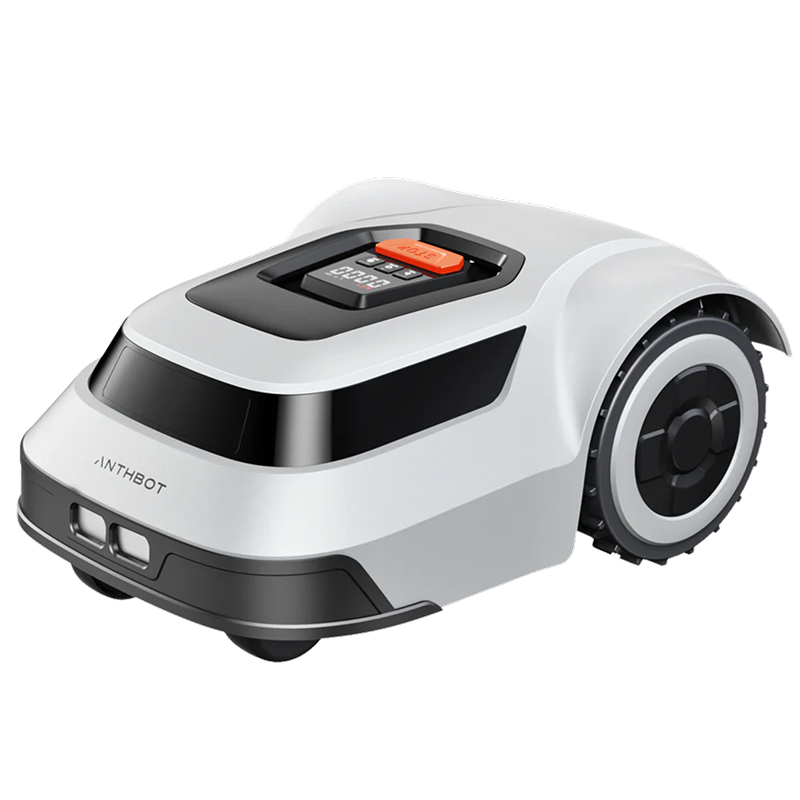
The ANTHBOT M5 Robot Lawn Mower is built around exactly this philosophy:
- App-Adjusted Cutting Height (3 cm – 7 cm): Adjust the deck from 3 to 7 cm directly in the ANTHBOT App. Seasonal changes take seconds, not a trip to the shed.
- Intelligent Mowing Schedule: The app plans schedules for up to 20 zones using local sunrise/sunset data and live rain sensor readings, so the M5 mows intelligently and frequently, the most effective way to ensure grass never exceeds the 1.5x trigger point.
- RTK + Vision + 4G Full-Yard Coverage: Full-Band RTK, dual HDR vision cameras, and 4G connectivity deliver centimetre-level navigation accuracy across your entire garden. This means no missed strips, no uncut patches that grow tall and get scalped.
- Wire-Free Setup in 10 Minutes: No boundary wire means virtually zero setup friction. The easier the routine, the more consistently it is followed.
Designed for gardens up to 500 m², the M5 operates at ≤58 dB, is IPX6 waterproof, and uses AI obstacle detection trained on over 1,000 object types.
Optimal Grass Mowing Height Chart (By Season & Grass Type)
The table below is a quick-reference guide calibrated for European climates. For a deeper look at European grass varieties, see the ANTHBOT grass type overview. When in doubt, cut higher. Longer grass is almost always more resilient during periods of stress.
|
Grass Type |
Early Spring |
Late Spring / Early Summer |
Midsummer (Heat) |
Autumn |
Late Autumn / Winter |
|
Perennial Ryegrass |
3.5 – 4 cm |
4 – 5 cm |
5 – 6 cm |
4 – 5 cm |
3.5 – 4 cm |
|
Fine Fescue |
3 – 3.5 cm |
3.5 – 4.5 cm |
4.5 – 5.5 cm |
3.5 – 4.5 cm |
3 – 3.5 cm |
|
Tall Fescue |
4 – 5 cm |
5 – 6 cm |
6 – 7.5 cm |
5 – 6 cm |
4 – 5 cm |
|
Bentgrass |
2 – 2.5 cm |
2.5 – 3.5 cm |
3 – 4 cm |
2.5 – 3.5 cm |
2 – 2.5 cm |
Spring: Waking Up the Lawn (3.5 cm – 4 cm)
A slightly lower cut in early spring removes dead, matted winter growth and encourages the grass to grow laterally, stimulating new tillers that fill in bare patches and create a denser, more weed-resistant turf.
Do not mow wet or frosted grass, and always use the step-down method if the lawn has grown long over winter. Pairing the first cut with a full spring garden clean-up: scarifying, aerating, and feeding, sets up a strong season.
Summer: Raising the Deck for Heat Defence (5 cm – 7.5 cm)
Counterintuitive but critical: raise your mower deck in summer, not lower it. Longer grass shades the soil to reduce moisture evaporation, and a dense canopy of 6–7.5 cm blocks light at soil level, preventing weed seeds from germinating entirely without any chemicals.
Studies from Purdue University's Turfgrass Science also consistently link taller cutting heights to deeper root systems, making the lawn more drought-tolerant. Aim for a minimum of 5 cm, and go up to 7.5 cm during prolonged dry or hot spells.
Autumn & Winter: Prepping for the Cold (4 cm – 5 cm)
From September onwards, gradually step the cutting height back down from your summer high. Apply the 1/3 rule to each reduction; never drop dramatically in a single session.
By mid-autumn, most European lawns should sit at 4–5 cm: short enough to prevent grass blades matting on the soil surface, which is a primary cause of snow mould (Microdochium nivale) and fungal disease. In winter, mow only during mild spells, keep the blade at 3.5–4 cm, and never mow frosted or waterlogged grass.
Why Your Mowing Height Matters (More Than You Think)

Every cut is a biological intervention, not just a cosmetic one. Understanding the science behind the 1/3 rule is what turns it from a vague guideline into an instinct.
The Biological Impact of Scalping
Grass leaves are the plant's photosynthetic organs: the surface through which sunlight is converted into the energy that fuels all growth. Research on perennial ryegrass published in Functional Plant Biology demonstrates that increased defoliation intensity directly limits photosynthetic activity and delays regrowth, reinforcing why conservative mowing practices are critical for turf health.
Remove 50% or more in one cut, as happens when a lawn is left for weeks and then scalped, and the plant's energy production is halved almost instantly. The visible results are yellowing, browning, thinning, and a prolonged recovery period that can stretch to four weeks, even with adequate watering and feeding.
Nutrient Depletion and Disease Susceptibility
When photosynthetic capacity collapses after a severe cut, the grass plant mobilises root carbohydrate reserves to fuel emergency leaf regrowth. The root system contracts, becoming shallower and less able to access water and nutrients.
A plant in this weakened state is significantly more susceptible to fungal pathogens, including Fusarium and Rhizoctonia species responsible for red thread and brown patch, as well as increased insect pressure.
Turfgrass pathology research shows that management-induced stress, particularly practices such as close mowing, plays a major role in disease development in cool-season grasses. As outlined in Turfgrass Management (Turgeon, 2012), mowing intensity is a key cultural factor influencing turf health and its susceptibility to environmental and biological stresses.
FAQs About Mowing Heights
What is the healthiest height to cut grass?
For the cool-season grasses most common in European gardens, a general target of 4-6 cm suits the main growing season. In summer, lean towards 5-7.5 cm to protect soil and suppress weeds. In spring, 3.5-4 cm encourages lateral growth.
Whatever the season, always apply the 1/3 rule; never remove more than one-third of the blade's current height in a single cut.
Is 10 cm (4 inches) too tall for grass?
Not inherently, but cutting it back to 4 or 5 cm in one pass would remove over half the blade height, violating the 1/3 rule. Use the step-down method: cut to roughly 6.5-7 cm first, wait 2-3 days, then bring it to your target height. Meadow or naturalised lawns are the exception, where 10 cm or taller may be entirely intentional.
Is October too late to cut grass?
No. October is an important month for the autumn step-down cut in most European gardens. Grass continues growing until soil temperatures drop below 5°C, typically November or December in the UK and northern Europe.
Through October, gradually reduce height from your summer high down to 4-5 cm, honouring the 1/3 rule with each reduction. Avoid mowing after the first hard frost of autumn.


Leave a comment
This site is protected by hCaptcha and the hCaptcha Privacy Policy and Terms of Service apply.